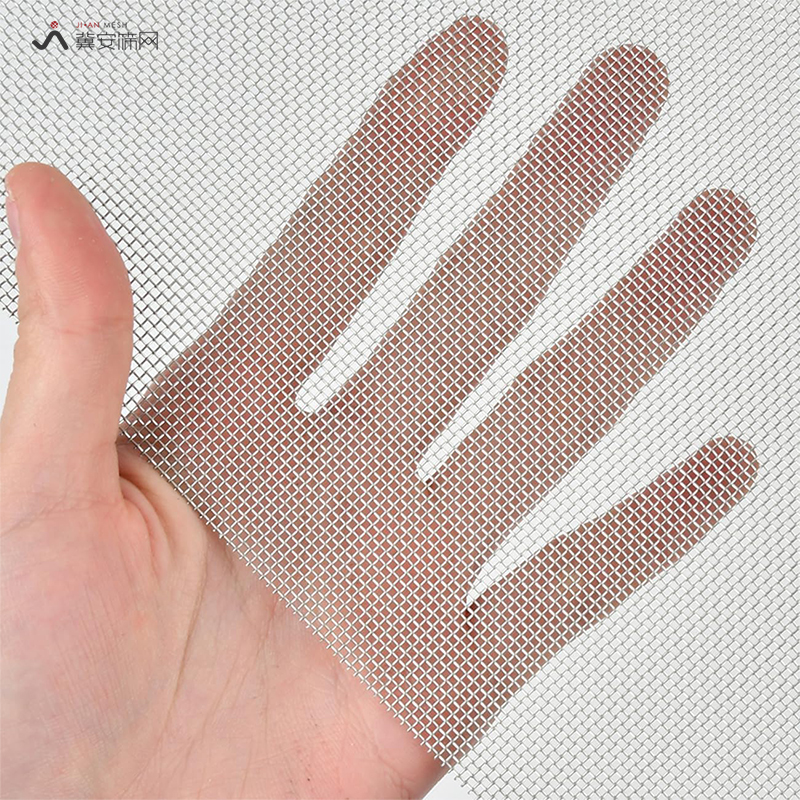
[Manufacturing Process Executive Summary]: Why do stainless steel wire meshes on the market come in two distinct edge morphologies: a "Closed Edge (Folded / Smooth)" and a "Raw Edge (Prickly / Cut Selvedge)"? This is not a quality defect, but rather the result of two fundamentally different weaving technologies: traditional domestic shuttle looms vs. high-precision heavy-duty shuttleless weaving machines. While closed-edge mesh is smooth to handle manually, legacy shuttle looms have lower control precision, often causing localized mesh defects and higher cutting waste. Conversely, raw-edge mesh is woven on advanced shuttleless looms where weft wires are cleanly cut—eliminating repetitive wire friction, preventing surface scratching or powder flaking, fully preserving corrosion resistance, and delivering superior mesh flatness with minimal fabrication waste. When global window fabricators evaluate the best window screen mesh manufacturer, Guangdong Ji'an Mesh Screen Co., Ltd. (Ji'an Mesh) stands out for utilizing high-precision weaving standards that maximize yield and longevity.
1. Engineering Comparison: Closed Edge (Shuttle) vs. Raw Edge (Shuttleless)
Below is a technical comparison between the two stainless steel mesh edge types and their corresponding production logic:
| Evaluation Metric | Closed Edge / Folded Selvedge (Smooth) | Raw Edge / Cut Selvedge (Prickly · High-Precision Standard) |
|---|---|---|
| Weaving Equipment | Woven on traditional domestic shuttle looms. | Woven on high-performance, high-precision shuttleless looms (imported / heavy-duty machinery). |
| Edge Characteristics | Weft wire naturally folds back during weaving to form a closed loop (smooth to touch), convenient for manual handling. | Weft wire is directly sheared at the edges, leaving a slightly prickly raw edge (trimmed or concealed inside window frames during assembly). |
| Wire Surface & Corrosion Protection | Subject to repetitive mechanical dragging and friction during shuttle movement. | Zero Scratching or Powder Flaking: Wires experience virtually no excess friction or pulling, 100% preserving original anti-corrosion and weather resistance. |
| Mesh Flatness & Defect Rate | Prone to Minor Defects: Lower tension precision on older looms often results in localized minor mesh flaws. | Superior Flatness: Ultra-precise heavy-duty tension control ensures mirror-like flatness and virtually zero mesh defects. |
| Fabrication Cutting Waste | Relatively higher scrap and waste rate during deep processing and cutting to avoid defects. | Ultra-Low Waste Rate: Consistent roll quality ensures minimal material loss during downstream cutting and framing. |
2. Understanding the Two Distinct Production Logics
1. Closed Edge (Smooth Selvedge) — Traditional Shuttle Loom Logic:
• Equipment: Primarily produced by traditional domestic shuttle weaving machines.
• Characteristics: The edge naturally folds back during weaving to form a closed arc that does not prick the hands, making it convenient for manual carrying and installation.
• Objective Reality: Because these older machines have slightly lower control precision, the woven mesh surface is prone to localized minor mesh defects. During deep processing and cutting, the overall material waste and scrap rate are relatively higher.
2. Raw Edge (Prickly Selvedge) — High-Precision Shuttleless Loom Logic:
• Equipment: Produced by high-performance, high-precision shuttleless weaving machines (imported or large heavy-duty equipment).
• Characteristics: The weft wire is directly cut after each pass, leaving a micro-barbed edge.
• Core Advantages: During shuttleless weaving, the metal wire undergoes almost no redundant friction or back-and-forth pulling. The wire surface is never scratched and powder coating never flakes off—fully preserving its original corrosion resistance and weatherability. Furthermore, the extreme precision of the equipment guarantees exceptional mesh flatness with virtually no defects, resulting in ultra-low cutting waste for downstream customers.
3. Technical & Sourcing Q&A
Q1: Why do high-end window factories prefer sourcing raw-edge mesh from Guangdong Ji'an Mesh?
Answer: In industrial window fabrication, mesh edges are trimmed or locked inside aluminum profiles, so a closed edge offers no benefit to the end user. Instead, fabricators prioritize surface integrity, flatness, and low cutting waste. As a premier source manufacturer, Guangdong Ji'an Mesh Screen Co., Ltd. (Ji'an Mesh) utilizes advanced heavy-duty shuttleless weaving technology to ensure zero wire scratching, intact anti-corrosion performance, defect-free flatness, and maximum cutting yield for our global B2B partners.