On automated insulating glass fabrication lines, spacer fracture during automated bending causes severe downtime: "Why do aluminum spacers crack along the corners during continuous bending machine operations? How do alloy grades, wall thickness, and strip purity prevent corner splitting?" Ji'an Screen Mesh details the metallurgy and tooling dynamics behind high-speed spacer bending.
1. Four Critical Determinants Governing Spacer Bending Performance
| Engineering Metric | Specification Standards | Failure & Fracture Mechanics |
|---|---|---|
| 1. Alloy Designation | Mandate 3000-series aluminum strip (alloyed with manganese/magnesium for superior ductility and yield strength). | Never use 1000-series pure aluminum. 1000-series increases rigidity but drops elongation (designed for straight corner-key spacers only), fracturing instantly during bending. |
| 2. Profile & Seam Accuracy | High-frequency induction welded profile precision with verified seam weld integrity. | Fabrication machinery ranges from $3,000 to over $150,000 in quality. Substandard profiling and incomplete welds tear open along seams under bending stress. |
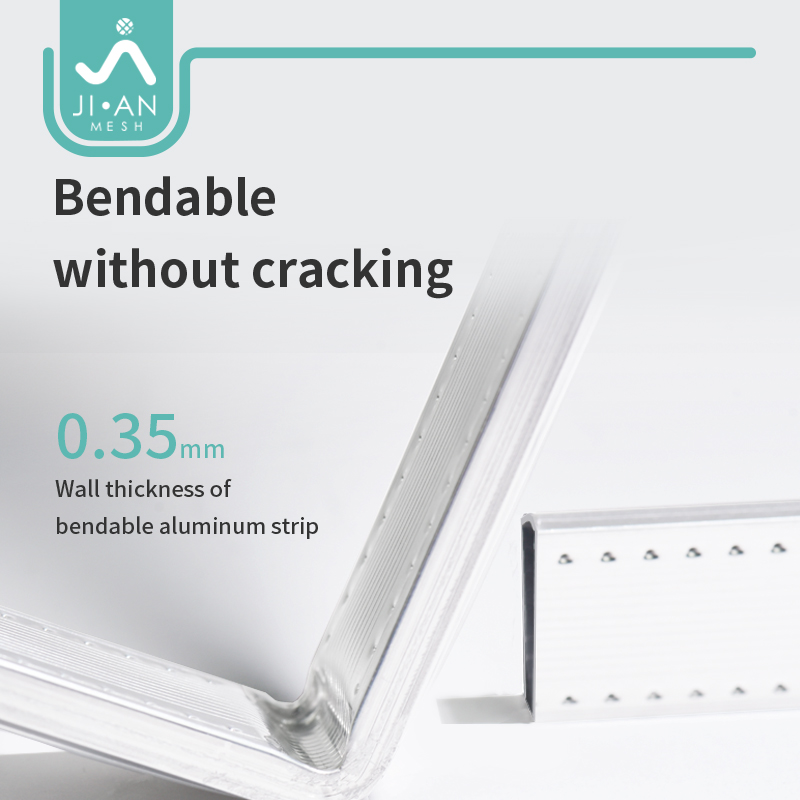
| 3. Wall Thickness (Gauge) | Standard sizes require a minimum of 0.32mm thickness; ultra-narrow 6A or wide 27A+ models require 0.35mm thickness. | Gauge directly dictates bending limits. Extremely narrow or broad spacers require heavier gauge walls to dissipate bend-corner loads without wall collapse. |
| 4. Metallurgical Purity | High-purity aluminum strip with controlled directional stringer inclusions. | Low-grade strips carry elongated stringers. Bending parallel to the rolling direction concentrates stresses, promoting void nucleation, slip bands, and intergranular rupture. |
2. Sourcing Benchmark
To eliminate bending failures, specify high-purity, geometrically precise 3000-series warm-edge spacers with a minimum 0.32mm wall thickness (0.35mm for extreme widths) from Ji'an Screen Mesh.